
The not-so-secret sauce of China's success
Unsexy plenums and their lugubrious readouts

Dear Global Jigsaw,
The 20th Central Committee of the Communist Party of China recently held its Fourth Plenary Session. I would not blame you, dear reader, if your eyelids grew heavy reaching the end of that sentence. But it is in these lugubrious sounding affairs that an understanding of China’s epoch-defining rise lies. The Chinese authorities are above all else, planners. They are also —counterintuitively for an authoritarian outfit— pivoters; course correctors. And it is in these meetings where policy-past is evaluated, and policy-future devised, that the answer to that million-yuan question: ‘how did they do it?’ resides.
How did China, a country that was on par with India on most economic indicators only a few decades ago, become so ascendant?
For all the years, 2002-2009, that comprised my first innings in the erstwhile Middle Kingdom, there was a determined band of western commentators who persistently predicted the imminent collapse of China regardless of the plentiful evidence to the contrary. China’s state-led capitalism aka Socialism with Chinese Characteristics in the local argot, simply did not compute for pundits whose worldviews were shaped by Washington Consensus axioms.
The oft repeated orthodoxy was that in the absence of political liberalization, China’s liberalizing economics would create an untenable contradiction. The Chinese Communist Party was attempting to square a circle. It would not succeed unless a list of prescriptions that included, political democratization, full financial liberalization and abandonment of industrial policy, was heeded.
Well, we now know how that panned out. The authorities in Beijing did not pay heed and today, China leads the world in production capacity and green energy. It dominates global supply chains. Beijing’s military strength is bolstered by huge defense budgets, cyberwarfare capabilities and the world’s largest navy by ship count. Shenzhen has emerged as a true rival to Silicon Valley as an incubator for tech entrepreneurship. China’s GDP per capita is about 13,500 USD. (In 2005, when I was writing about these things for the Hindu as their China correspondent, it was 1.700 USD.[1])
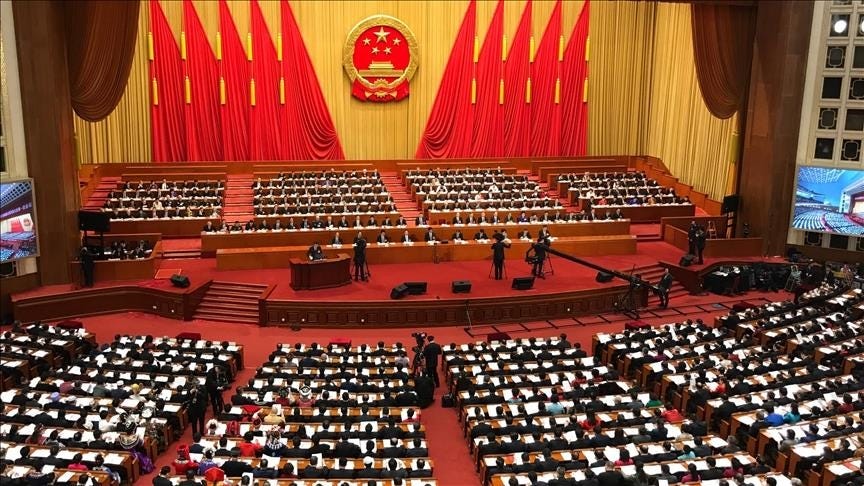
File picture
*** The rest of this piece is paywalled. You can become a paid subscriber by clicking on the button below. I do apologize, but writing is my primary vocation, not a hobby. I have kept the Global Jigsaw free to read for the last 4 years and those archives remain accessible to everyone. But going forward, only a part of each post will be accessible to non-paying followers. If you are unable to afford a subscription and there is a piece that you want to read in its entirety, message me. I will send you complimentary access****